01 / The performance challenge
Teach people how to judge, not just generate.
The Genesee County AI Literacy initiative needed a consistent, approachable learning experience spanning prompting, ethics, privacy, bias, and career applications. A central design choice was to treat AI output as a starting point to evaluate—not as an automatic answer.
02 / Design workflow
A human-reviewed AI development cycle.
Identify what the learner must recognize, decide, or do in real work.
Use AI-assisted drafting and design tools to explore multiple explanations, practice examples, and visual treatments.
Apply fact-checking, privacy, bias, copyright, readability, and accessibility checks before accepting a draft.
Use learner-facing activities, career situations, and checks for understanding—not just explanatory prose.
Review content and UI, revise for student clarity, and maintain alignment between objectives and assessments.
The public course teaches a five-tip prompting framework and a three-step audit routine. Those instructional concepts also exemplify the human-judgment approach brought to AI-supported production.
03 / Artifacts
Show the work, including the review.
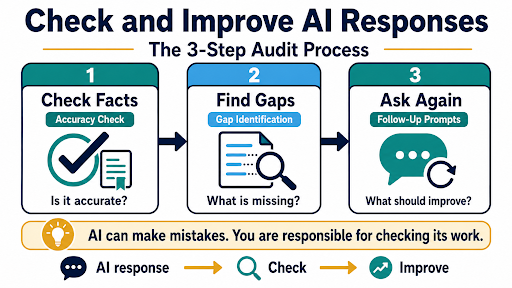
Further course artifacts include a privacy scanner, bias awareness visuals, career-focused activities, lesson-level assessments, and educator implementation resources.
04 / Responsible design
Where human review matters.
- Do not publish unverified facts or misleading AI-generated examples.
- Use accessible language and alternatives to image-only explanations.
- Protect personal information and minimize unnecessary data.
- Separate original learner outcomes from planned enrollment targets.
- Make materials editable and reviewable by collaborating educators.
Scope note: This is a reconstruction of the design approach reflected in the public course and its development context; it is not a claim that every draft followed an identical automated process or that a formal A/B test occurred.
Let's make learning useful.
Let's talk about building effective learning experiences for teams and organizations.
Contact Andrew ↗