01 / The challenge
AI literacy needs more than tool tips.
Students entering evolving careers need a usable foundation for both the possibilities and the responsibilities of generative AI. The instructional challenge was to make unfamiliar topics concrete and approachable without treating AI output as automatically accurate or appropriate.
02 / The learning design
From concept to confident practice.
The county initiative organized content into eight focused lessons, with a recurring experience: Watch, Learn, Apply, Career Connection, Check Your Understanding, and Go Deeper. This consistent structure made it easier for students and participating educators to navigate while keeping applied practice central.
Topics span AI fundamentals, prompting, images and media, ethics, privacy, bias, and future careers, culminating in a credential-focused final lesson.
03 / Applied learner experiences
Useful habits, not just definitions.
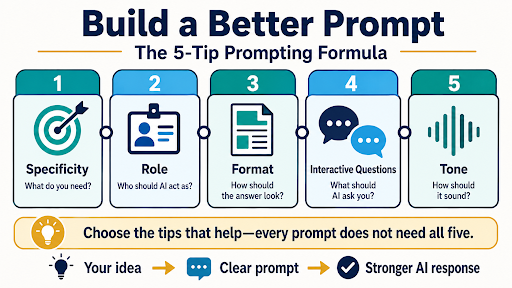
- Prompting: A five-tip prompting framework and a three-step audit routine for checking AI-generated output.
- Images and media: Activities about evaluating AI-created content and understanding authorship and permissions.
- Privacy and bias: Decision-making routines to help students identify what should not be shared and recognize uneven AI outcomes.
- Career connections: A practical bridge from each lesson to applications students may encounter on the job.
- Feedback: Short checks for understanding and optional extension resources.
04 / Delivery and measurement
Designed for adoption at scale.
The course was designed for an estimated 2,000 students and approximately 50 teachers, with web-based lessons, LMS-friendly delivery, assessments, and supporting materials. The public source repository contains eight lesson pages and assessment artifacts.
Evidence boundary: The participation figures above are planning targets, not verified enrollment or completion totals. This page documents the design and implementation approach without inventing outcomes.
05 / Explore the work
See the learning experience.
The public site provides the complete student-facing lesson sequence. The underlying repository demonstrates the actual curriculum organization and source assets.
Thinking about responsible AI learning?
Let's discuss how practical AI experiences can support performance and human judgment.
Contact Andrew ↗