01 / Mentor development
Transfer ownership instead of giving answers.
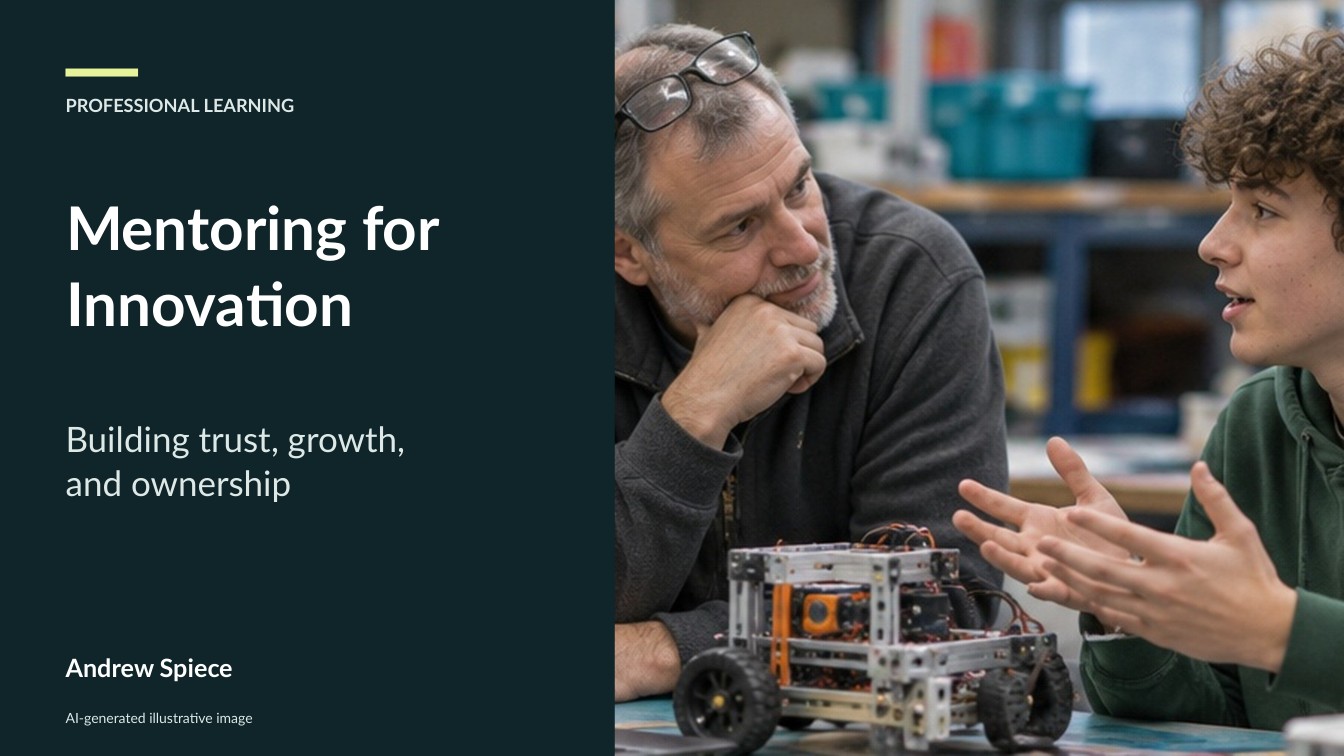
Mentoring for Innovation combines two completed mentoring presentations into a 15-slide professional development experience, with a five-phase framework, realistic scenario, partner practice and facilitator notes. The original presentations remain archived in the case study.
Explore mentoring case study and presentation ↗
Establish trust and a shared purpose.
Identify goals and agree on what the mentoring relationship should achieve.
Use guided questions, feedback and reflection to support independent decisions.
02 / FIRST Mentor Camp
Use participant feedback to improve professional learning.
Archived mentor-camp planning materials and a completed survey-results presentation document the work of organizing professional learning for robotics mentors. The survey synthesis, co-authored with Ellen Crain, identified requests for more hands-on programming, team sustainability, technical mentoring and practical examples.
The evidence demonstrates a feedback-informed approach to event design. It does not establish measured changes in mentor performance. Individual survey responses and participant information remain private.
03 / Conference presentations
Translate emerging standards into practical decisions.
At MICE Con in October 2026, I presented two sessions: The New CSTA Standards: High School Foundations and Specialty Pathways and AI Literacy for Career-Ready Students. The standards session was structured around foundational expectations, specialty pathways and a concrete planning activity for educators. The AI literacy session connected responsible AI education with career preparation.
The standards presentation adapted materials from NJ CSTA and credits CSTA's 2026 materials under CC BY-NC-SA 4.0. The original third-party slides are not reproduced in this portfolio.
04 / Evidence and scope
Document completed work responsibly.
These are summaries of completed presentations and archived program materials. The mentoring case study links to original presentations already shared with anyone who has the link. Private source documents, attendee records and survey responses are not published. Collaborative contributions are acknowledged; attendance and learning-outcome claims are not inferred from slide decks.
Let's make learning useful.
Let's talk about building effective learning experiences for teams and organizations.
Contact Andrew ↗